
The Importance of Airflow, Temperature & Humidity in a Grow Room
The Importance of Airflow, Temperature & Humidity in a Grow Room
Creating the perfect environment inside your grow room isn’t just a matter of comfort for your plants - it’s the foundation of healthy growth, efficient photosynthesis, and strong yields. Three environmental factors matter more than anything: airflow, temperature, and humidity. When these elements are balanced, plants thrive; when they’re not, even the best genetics and nutrient programs can’t reach their full potential.
Below, we dive into each element and take a closer look at VPD (Vapour Pressure Deficit) - one of the most important yet misunderstood concepts in controlled growing.
Why Airflow Matters in a Grow Room

Airflow is the life force of an indoor garden. Proper circulation helps achieve three crucial goals:
1. Fresh CO₂ for Photosynthesis
Plants constantly consume CO₂ as they photosynthesise. Without movement, CO₂ becomes depleted near the leaf surface. Good airflow ensures a steady supply of CO₂, keeping photosynthesis efficient.
2. Strengthening Plant Structure
A gentle breeze causes plants to sway, triggering strengthening of cell walls - similar to how muscles strengthen with exercise. This results in sturdier stems capable of supporting heavier flower or fruit weight.
3. Preventing Pests & Mould
Stagnant, humid air is a breeding ground for:
-
Botrytis (grey mould)
-
Fungus gnats and flying pests
Consistent airflow keeps moisture from settling and discourages pathogens from taking hold.
Temperature: The Engine Behind Metabolism

Temperature directly determines how fast your plants grow. Photosynthesis, respiration, and nutrient uptake all depend on maintaining optimal temperature ranges.
Grow-room temperature targets (a rule of thumb)
-
Vegetative phase: 22-26°C (72-79°F)
-
Flowering phase: 20-25°C (68-77°F)
Too cold → slows growth, reduces nutrient uptake
Too hot → increases respiration, causing stress and reduced yield
Temperature also directly affects your humidity levels, and together they influence VPD.
Humidity: More Than Just Moisture in the Air

Humidity affects plant transpiration - the process where plants release water vapour through tiny pores called stomata. The right humidity helps plants efficiently move nutrients from roots to leaves.
Common humidity ranges (a rule of thumb)
-
Seedlings/cuttings: 65-75% RH
-
Veg: 55-70% RH
-
Flower: 40-55% RH
Humidity that's too high can encourage mould; too low forces plants to transpire excessively, causing stress.
Understanding VPD (Vapour Pressure Deficit)
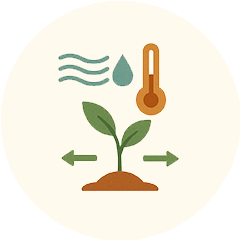
VPD is one of the most powerful tools for dialling in your grow room environment. It's a measurement of the difference between the amount of moisture the air can hold when fully saturated vs. how much moisture is actually in the air.
Think of VPD as a measure of “drying power” of the air.
Why VPD matters:
-
Controls transpiration rate
-
Influences nutrient uptake
-
Impacts stomatal behaviour
-
Directly affects photosynthesis efficiency
When VPD is in the right range, plants open their stomata comfortably, allowing:
-
More CO₂ absorption
-
Better water + nutrient movement
-
Faster growth
When VPD is too high (air too dry):
→ Plants lose water too quickly
→ Stomata close to protect themselves
→ Photosynthesis slows
→ Leaves may curl or show burn-like symptoms
When VPD is too low (air too humid):
→ Plants transpire too slowly
→ Nutrient uptake stagnates
→ Risk of mould increases
Common VPD ranges (a rule of thumb)
-
Seedlings/cuttings: 0.4-0.8 kPa
-
Veg: 0.8-1.2 kPa
-
Flower: 1.0-1.5 kPa
These match our VPD chart. The temperature, humidity and VPD ranges will not always agree, because warmer air at the same humidity has more drying power. At 20°C, the whole 40-55% flowering range sits inside 1.0-1.5 kPa on the chart; at 24°C, 40-45% reads 1.79-1.64 kPa, too dry, while 50-55% reads 1.49-1.34, inside the range. So in a warm room, keep humidity near the top of its range.
Products That Help Maintain a Good Grow Room Environment
1. Airflow & Extraction
| Type | Fans | Their pages say |
|---|---|---|
| Clip fans | AC Infinity Cloudray Clip Fans, Maxifan Clip Fan 200mm | Cloudray 100-225 mm: smaller for small tents and propagation, lower speeds for seedlings |
| Wall fans | Gorilla Wall Fan 16 inch, Ora 16 inch Wall Fan, WindKing Wall Fan, Tornado DC 18 inch Wall Fan | All oscillate; WindKing (40 cm, 55 W) sweeps an O pattern |
| Floor fans | Gorilla Metal Floor Fans | 12-20 inch, 3 speeds; can hang from a ceiling |
| Pedestal fans | Tornado DC 18 inch Stand Fan, Tornado DC 26 inch Stand Fan | Oscillating, DC motor: up to 70% less power than AC fans, says the maker; 18 inch for tents and smaller rooms; both take the 2-litre Tornado DC Mister Attachment |
| Air diffuser | G.A.S DiffuseAir | Fits your fan and ducting, 100-250 mm; spreads air, no blast |
Size the extractor fan, ducting and carbon filter with our fan and filter guide.
2. Temperature Regulation
-
Portable Air Conditioners - For sealed rooms or hot climates.
-
Heaters - Gentle background warmth from a tube heater on a separate thermostat, or quicker heat from a 2 kW fan or space heater. Our advice: keep a 2 kW heater in the room rather than inside a tent, with clear space around it. For an automated set-up, the AC Infinity Thermoforge T7 VPD Heater adjusts its heat output for a balanced VPD and works with the AI+ Controller, its page says. Our grow room and greenhouse heaters guide compares them and the thermostats to use.
-
AC Infinity Controllers / GAS Systems - Automate climate management.
3. Humidity Control
-
Humidifiers (ultrasonic or evaporative) - Ideal for veg and early growth.
-
Dehumidifiers - Lower the humidity in flowering when extraction cannot keep up, to cut the risk of grey mould.
-
Humidity Controllers - Automate a humidifier with the G.A.S Intelligent Humidity Controllers, or a dehumidifier with the dehumidifier model of the G.A.S Day & Night Controllers.
4. Monitoring Tools
-
Digital Hygrometers/Thermometers - Always have at least two in your space.
5. Adding CO2 in a sealed room
As a rule of thumb, added CO2 works best in a sealed room under strong light (see our LED wattage guide): an extracted tent blows it straight back out. With no extractor, cooling and a dehumidifier must remove heat and moisture. The CO2 equipment we sell:
-
ExHale CO2 Bags - Mycelial mass in the bag gives off CO2 continuously, with no bottle and no switch. Its page says each bag lasts around 3-6 months after purchase and covers 4-6 large plants or roughly 16 square feet.
-
Mother Nature CO2 Generator - A bucket generator; its page says it is designed with sealed rooms in mind and lasts around 6 months: 5 litre for areas up to 1.5 m², 10 litre up to 2.4 m². Each size comes as bucket and pump, or as a refill.
-
Pro-Leaf CO2 Controller and Pro-Leaf CO2 Regulator - A pair for CO2 from a bottle: the regulator turns the flow on and off to hold the level you set on the controller, whose light sensor means CO2 is only added when needed, such as during the day, its page says.
-
RAM CO2 Monitor & Controller - A 2-in-1 monitor and controller with a 24-hour log of CO2 levels; its page says it needs a compatible CO2 regulator but names none: ask us.
-
Hydrogarden CO2 Regulator Release Kit - An adjustable, ready-assembled regulator with CO2 tubing, for a vapour release CO2 bottle; its page names no controller. We do not sell the bottle this kit or the Pro-Leaf regulator needs.
-
Thermo/Hygrometer With CO2 Monitor - Shows temperature, humidity and CO2, with alerts you set for CO2 too high or too low.
The Hydrogarden page warns that CO2 is an asphyxiant in high concentrations, and asks you to monitor CO2 levels so there is no build-up or danger to people or animals.
Creating an ideal grow environment isn’t about chasing perfect numbers - it’s about balance. Airflow keeps plants breathing, temperature fuels their metabolism, humidity regulates transpiration, and VPD brings everything together into one cohesive standard.
Quick answers
Which circulation fan for a tent or a room?
Our advice: clip fans for tents; oscillating wall or pedestal fans for rooms, or a floor fan hung from the ceiling; a DiffuseAir where ducted air would blast plants. None replaces the extractor fan.
More Growers' Guides
- Heating a grow tent or greenhouse
- Grow tent humidity
- VPD chart
- Fan and carbon filter size
- Grow tent intake and ventilation
Not sure what you need? Call the shop on 0117 971 3000 or pop in to the Bristol store and we'll help you pick.